.svg)
iGaming Software Development: The Complete Guide for Operators (2026)
By
SoftVault Team
August 7, 2026
•
9 min read

✦ TL;DR AI-assisted. Reviewed by SoftVault Editors.
- Building an iGaming platform from scratch takes 12–24 months and a seven-figure budget — the hard parts are game aggregation, payments, and compliance.
- Most operators launch faster and cheaper on a proven platform: live in about 14 days from a €10k–€15k setup fee, so budget goes into players and brand, not infrastructure.
Every online casino, sportsbook, and crypto-gaming brand runs on the same invisible foundation: its iGaming software. It is the layer that manages players, moves money, serves games, applies bonuses, and keeps the operation compliant. Get it right and you have a platform that scales to thousands of concurrent players; get it wrong and you are firefighting downtime and failed payments while your marketing budget burns.
This guide explains what iGaming software development actually involves in 2026 — the core components of a modern platform, the real decision between building in-house and partnering with a provider, realistic timelines and costs, and what to look for when you choose who builds your technology.
What is iGaming software development?
iGaming software development is the design, engineering, and integration of the systems that power real-money online gaming. It spans the player-facing frontend, the operator back office, and the dozens of third-party integrations in between — game studios, payment processors, KYC vendors, and regulators. Unlike a typical web application, iGaming software has to handle real-money transactions, strict regulatory requirements, thousands of games from competing providers, and fraud attempts, all in real time and at scale.
That combination is what makes casino software development genuinely hard. The frontend is the easy part; the value sits in the wallet, the game aggregation layer, payment orchestration, and the compliance tooling underneath it.
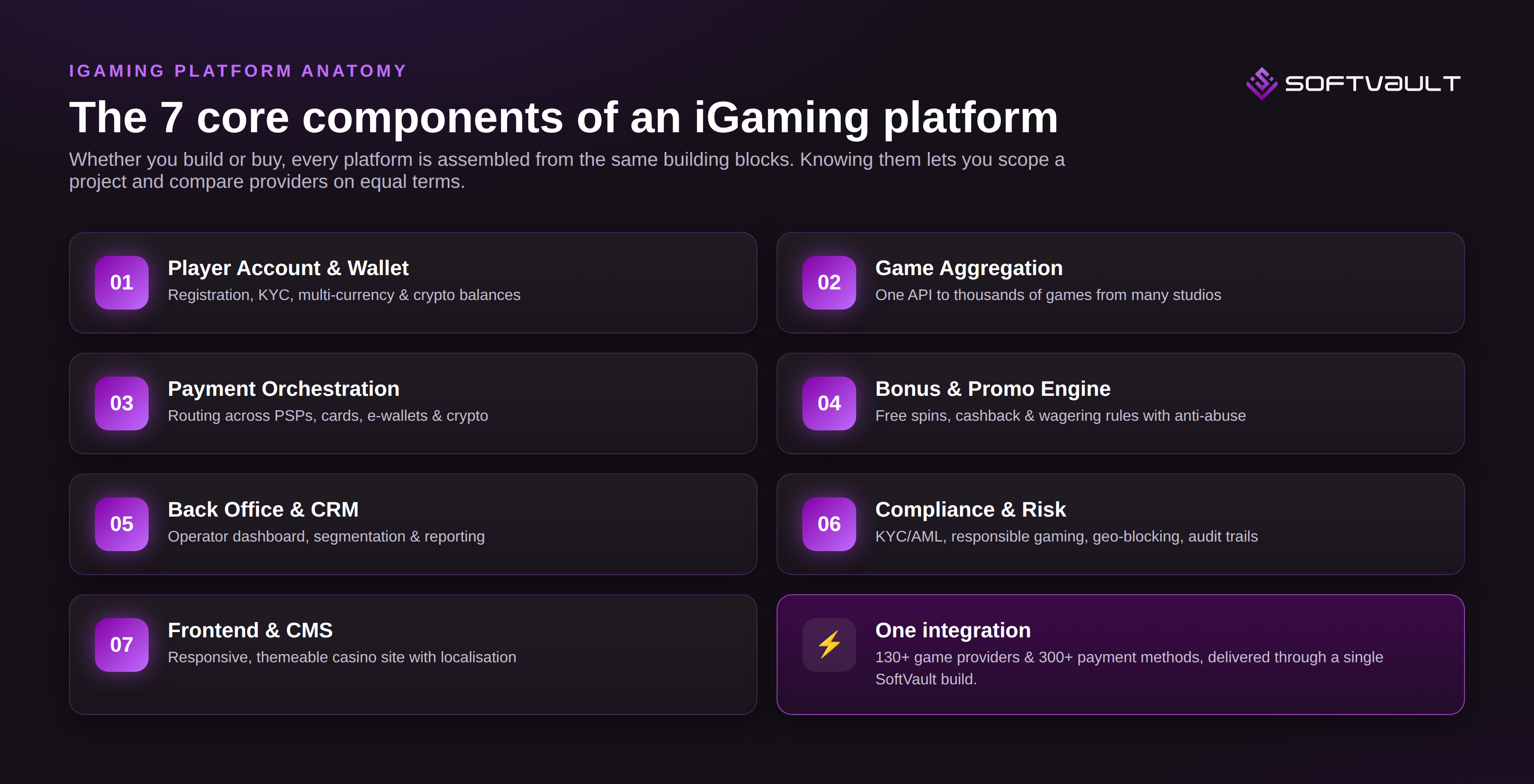
The core components of an iGaming platform
Whether you build or buy, a complete platform is assembled from the same building blocks. Knowing them helps you scope a project and compare providers on equal terms.
| Component | What it does |
|---|---|
| Player account & wallet | Registration, authentication, KYC, multi-currency and crypto balances, transaction history |
| Game aggregation layer | A single API that connects thousands of games from many studios — the hardest integration to build alone |
| Payment orchestration | Routing deposits and withdrawals across PSPs, cards, e-wallets, and crypto with retries and reconciliation |
| Bonus & promotion engine | Welcome offers, free spins, cashback, and wagering rules with anti-abuse controls |
| Back office & CRM | Operator dashboard, player management, segmentation, and financial reporting |
| Compliance & risk | KYC/AML checks, responsible-gaming tools, geo-blocking, and audit trails |
| Frontend & CMS | A responsive, themeable casino site with content management and localisation |
Build in-house vs. partner with a provider
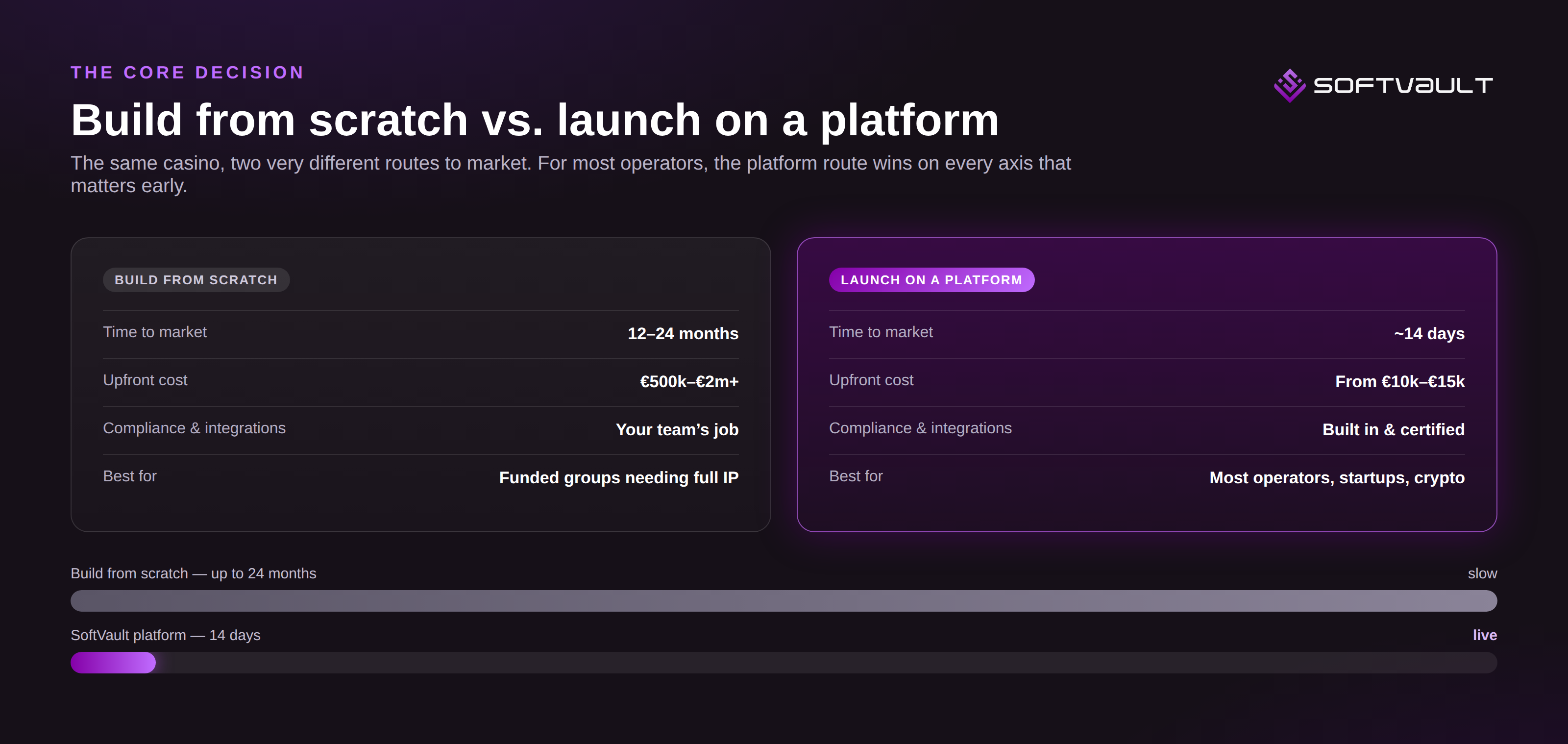
This is the decision that defines your budget, your timeline, and your risk. There are three realistic paths, and they suit very different operators.
| Approach | Time to market | Upfront cost | Best for |
|---|---|---|---|
| Build from scratch | 12–24 months | €500k–€2m+ | Well-funded groups that need to own the full IP |
| License a platform (turnkey / white label) | 2–4 weeks | From €10k–€15k | Most operators, startups, and crypto brands |
| Hybrid (platform + custom work) | 4–10 weeks | €15k+ | Operators with specific UX or feature needs |
For the vast majority of new and mid-size operators, building the entire stack from zero is the wrong bet. You spend a year and a fortune rebuilding wallet, aggregation, and payment systems that already exist as mature, certified products — time your competitors spend acquiring players. Building in-house makes sense only when full IP ownership is the business, not the brand on top of it. Most operators are better served by a turnkey casino solution or a white-label platform, then investing their capital and customisation budget where it differentiates them.
How long does iGaming software development take?
From scratch, plan on 12–24 months to reach a compliant, launch-ready platform — longer once you add certification and licensing. On an established platform, a standard casino goes live in 14 days, with heavier customisation, a sportsbook, or poker integration extending that timeline by a few weeks.
What iGaming software development costs
A from-scratch build runs into the hundreds of thousands before a single player registers, and that is only the platform — games, payments, and licensing are separate. Licensing a platform collapses that into a setup fee from €10,000–€15,000 plus an ongoing revenue share, with third-party game and payment fees layered on top. For a full breakdown of one-time and ongoing costs, see our guide on how much it costs to start an online casino in 2026.
Key technical considerations
Scalability and performance
Traffic in iGaming is spiky — a promotion or a big sporting event can multiply concurrent players in minutes. The platform must scale horizontally and keep the wallet consistent under load, because a slow or double-counted balance is an instant trust problem.
Security and DDoS protection
Real-money sites are constant targets. Expect DDoS mitigation, encryption in transit and at rest, and rigorous access controls as baseline, not extras. SoftVault includes Cloudflare and infrastructure-level DDoS protection in the standard build.
API-first architecture
Modern platforms are API-first, so games, payments, and CRM tools can be added or swapped without rebuilding the core. This is what makes fast integrations and clean customisation possible.
Mobile and provably fair
The majority of play is on mobile, so a responsive, app-quality experience is essential. Crypto-focused brands should also look for provably fair gaming and native crypto payment support built into the platform.
How to choose an iGaming software provider
Once you decide to license rather than build, the provider becomes your most important commercial partner. Weigh candidates on a handful of things that actually matter: proven live brands you can inspect, real game and payment coverage, genuine customisation options, hands-on compliance and licensing support, a credible time-to-market, and transparent pricing with no surprises.
SoftVault was built around exactly that shortlist: turnkey, white-label, and crypto casino platforms that go live in 14 days, 300+ payment methods and full game aggregation through one integration, and licensing support bundled into a single build — so your capital goes into traffic and brand rather than infrastructure.
Frequently Asked Questions
What is iGaming software development?
It is the design, engineering, and integration of the systems that run real-money online gaming — the player wallet, game aggregation, payment orchestration, bonus engine, back office, and compliance tooling, plus the frontend players see.
Should I build my own iGaming platform or use a provider?
Building from scratch takes 12–24 months and a seven-figure budget and only makes sense when owning the full technology IP is the business. Most operators launch faster and cheaper on a turnkey or white-label platform and spend their budget on customisation and marketing instead.
How long does it take to develop iGaming software?
A from-scratch build is a 12–24 month project. Launching on an established platform takes about 14 days for a standard casino, a little longer with a sportsbook or poker.
How much does iGaming software development cost?
From scratch, budget €500k–€2m+. Licensing a platform starts from a €10,000–€15,000 setup fee plus a revenue share, with separate game-provider and payment fees.
What should I look for in an iGaming software provider?
Proven live brands, broad game and payment coverage, real customisation, compliance and licensing support, a fast and credible time-to-market, and transparent pricing.